Dwellwise Picks
Browse
Smart climate

Smart Ceiling-Fan Controller Buying Guide: RF Compatibility, Speed, and Fallback

Current retailer option

Bond Bridge BD-1000 Smart RF Ceiling-Fan and Shade Controller

Check current price & availability on Amazon

Current price & availability · purchase link

Open the exact family listing to compare the live price, availability, delivery, seller, and returns.

Choose between an RF bridge, in-wall fan control, receiver module, or connected fan by motor type, remote protocol, separate light control, local fallback, and household workflow.

Prepared by the Dwellwise Picks editorial deskUpdated August 10, 2026

Quick answer

The practical answer

Start with the fan's motor, receiver, remote frequency, and wall wiring. An RF bridge is the least invasive choice for a compatible remote-controlled fan, while an in-wall control or receiver may offer clearer local operation. Do not put a fan motor on a lighting dimmer.

Common buying question

What is the best way to add smart control to an existing ceiling fan with a remote?

Current climate pages do not compare RF learning, fan-speed command state, light-channel separation, wall-control conflicts, and manual recovery.

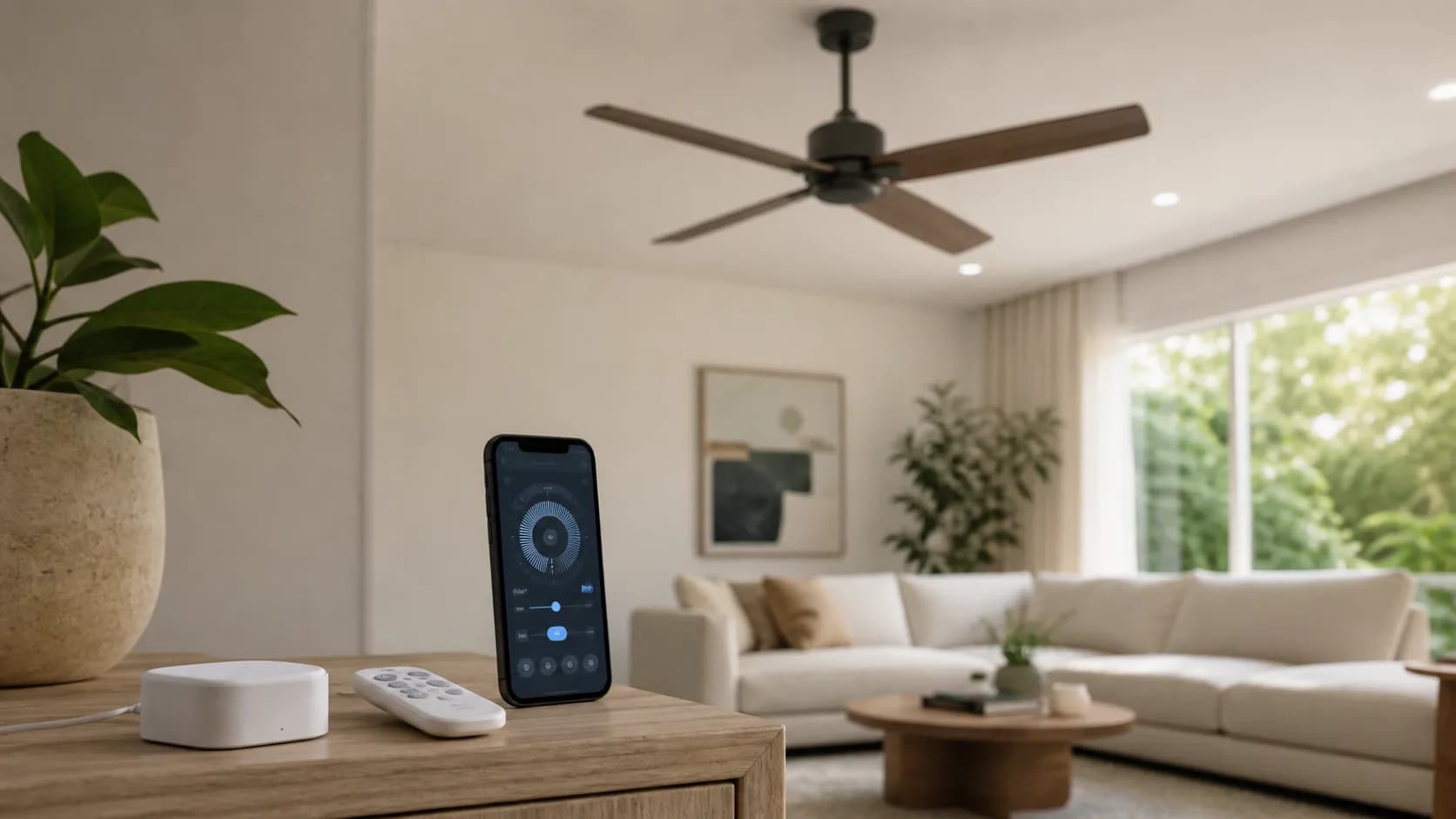
Editorial living-room climate scene representing smart ceiling-fan control
Original editorial image for category, fit, and use context; verify the exact linked product appearance and configuration on the retailer page.

Identify the existing control path

Record fan brand and model, AC or DC motor, canopy receiver, remote model and frequency, number of speeds, reverse control, light kit, dimming, wall conductors, and any pull chains. A remote that looks similar may use a different protocol, and a fan that supports RF is not automatically compatible with every RF bridge.

Understand what an RF bridge does

A bridge learns or selects supported radio commands and retransmits them from a fixed location. It does not become part of the motor circuit. That simplifies installation, but one-way RF can leave the app's displayed state different from the actual fan after someone uses the original remote or a command is missed.

Treat motor control as motor control

Use only controls listed for the exact fan and motor type. A lighting dimmer is not a fan-speed controller. Confirm load limits, neutral and traveler requirements, receiver compatibility, canopy clearance, electrician needs, and whether light and fan conductors can be controlled separately before changing wiring.

Map platform and outage behavior

List what works from the original remote, wall control, local network, vendor app, Alexa, Google, SmartThings, Home Assistant, and any Matter bridge. Test router and internet outages plus power restoration. Keep a labeled physical control available so a guest can operate the fan without an account.

When to skip the retrofit

Keep the original remote when automation is occasional, compatibility cannot be proven, or the bridge cannot reliably reach the receiver. Choose a compatible in-wall or canopy solution when true local state and physical control matter. Replace the fan only when the fan itself is due for replacement, not merely to collect another smart-home badge.

Current Amazon option

Check this exact product

Bond Bridge BD-1000 Smart RF Ceiling-Fan and Shade Controller

ASIN
B071GVGVVH
Brand
Bond
Listing checked
8/10/2026

Compare the current title, ASIN, variant, seller, stock, shipping, price, and return path before ordering.

Side-by-side checks

Four ways to make a ceiling fan smart

CheckBest fitMain limit
RF bridgeExisting compatible handheld-remote fanMay transmit commands without reading the fan's true state.
In-wall fan controlCompatible AC motor and suitable wall wiringCannot be treated as a generic light dimmer.
Canopy receiverFan supports the exact receiver and there is canopy spaceInstallation and model matching are more involved.
Factory-smart fanReplacing the whole fan already makes senseHighest cost and may still depend on an app or cloud.
Separate light channelFan and light can be controlled independentlyNot every remote or retrofit exposes both functions.
Manual fallbackPhysical control remains understandableRemote-only recovery is fragile when batteries or services fail.

Primary sources

References used for this guide

How this page was governed

Page-specific editorial method

  1. 1.Identify the exact fan, motor, receiver, remote, frequency, and wall conductors before selecting a retrofit.
  2. 2.Compare RF bridges separately from devices that directly switch or regulate motor power.
  3. 3.Test state synchronization and manual recovery rather than counting voice-platform logos.
  4. 4.Use the current manufacturer compatibility checker and exact Amazon identity at the publication gate.

Related guide

Smart Wall Switches Buying Guide

Which smart wall switches are worth buying when the real job is to control a fixed lighting circuit while keeping a dependable physical control for everyone? This guide turns that question into model-level checks, a reversible setup, a first-year ownership plan, and a clear skip decision.

Related guide

Smart Wall Switches: Compatibility and Fit Guide

Will smart wall switches fit the exact user, space, equipment, and installation path? This guide turns that question into model-level checks, a reversible setup, a first-year ownership plan, and a clear skip decision.

Related guide

Matter Hubs and Bridges Buying Guide

Which matter hubs and bridges are worth buying when the real job is to connect Matter devices or bridge an existing ecosystem into one or more controller platforms? This guide turns that question into model-level checks, a reversible setup, a first-year ownership plan, and a clear skip decision.

Related guide

Smart Tower Fan Buying Guide: Airflow, Noise, Oscillation, and App Control

Choose a connected tower fan by room layout, usable airflow, speed and noise range, oscillation, cleaning access, tip stability, local controls, and automation value.

Related guide

Whole-Home Energy Monitor: Cloud, Local Data, and Installation Guide

Compare panel fit, sensor count, electrician work, network dependence, data retention, and actionable household decisions.

Related guide

Temperature and Humidity Sensors Buying Guide

Which temperature and humidity sensors are worth buying when the real job is to measure room conditions for comfort, storage, plant, or HVAC decisions? This guide turns that question into model-level checks, a reversible setup, a first-year ownership plan, and a clear skip decision.

Related guide

Temperature and Humidity Sensors vs. thermostat room sensors

Choose between temperature and humidity sensors and thermostat room sensors for one concrete job: measure room conditions for comfort, storage, plant, or HVAC decisions. Compare four product-level checks, ownership cost, and the failure mode you can actually recover.

Related guide

Temperature and Humidity Sensors: Compatibility and Fit Guide

Will temperature and humidity sensors fit the exact user, space, equipment, and installation path? This guide turns that question into model-level checks, a reversible setup, a first-year ownership plan, and a clear skip decision.

Smart Ceiling-Fan Controller Buying Guide: RF Compatibility, Speed, and Fallback