Open the exact family listing to compare the live price, availability, delivery, seller, and returns.
Choose a connected tower fan by room layout, usable airflow, speed and noise range, oscillation, cleaning access, tip stability, local controls, and automation value.
Prepared by the Dwellwise Picks editorial deskUpdated August 11, 2026
Quick answer
The practical answer
Match airflow and oscillation to the occupied zone, then compare sound at the speeds you will actually use, not only the lowest advertised setting. Confirm a stable base, guarded intake, cleanable grille, local panel, remote storage, sleep-display controls, and restart behavior. App scheduling and voice speed changes are useful when they reduce nighttime interaction; they do not cool room air like an air conditioner.
Common buying question
Which smart tower fan is quiet enough for a bedroom, and does app control add anything beyond the remote?
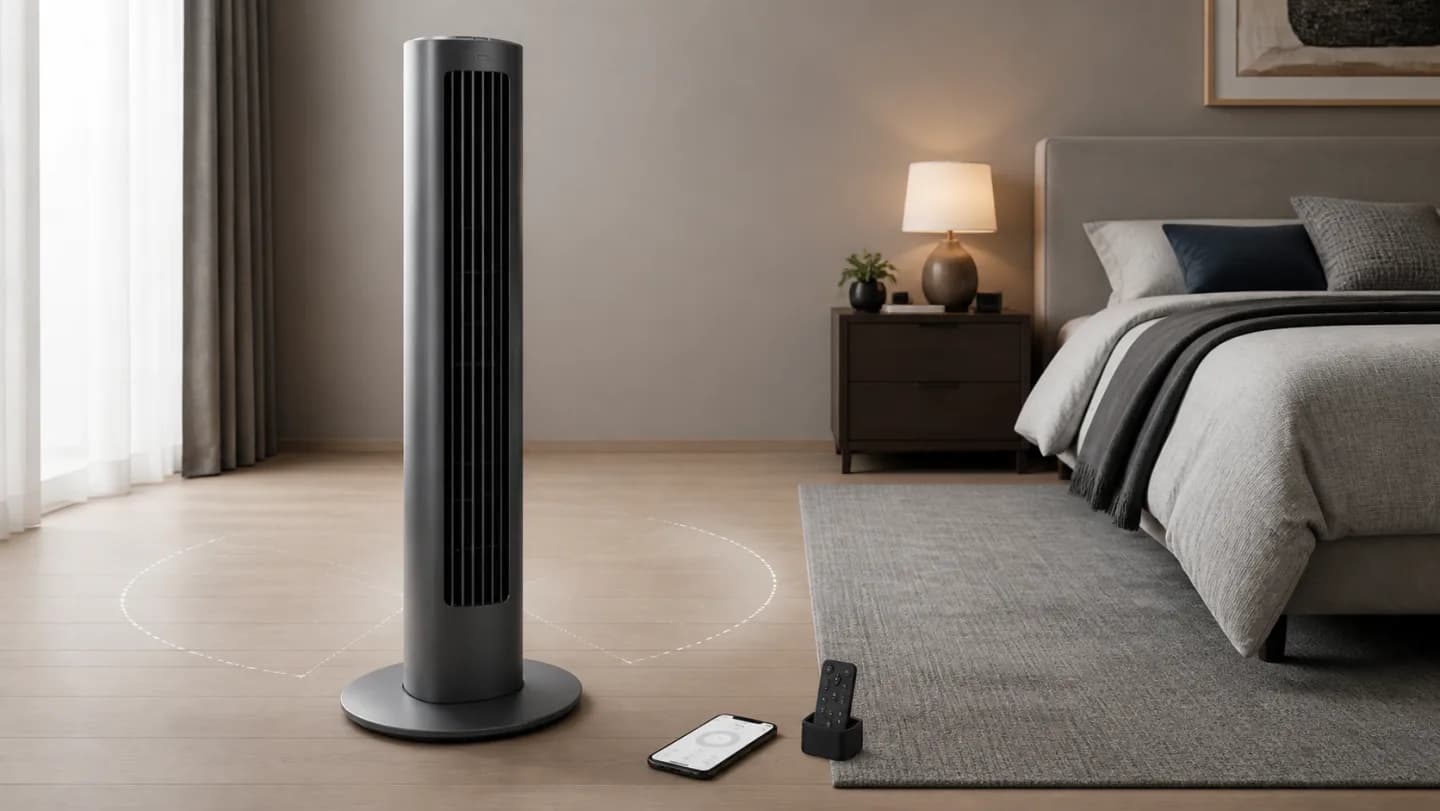
Original editorial image for category, fit, and use context; verify the exact linked product appearance and configuration on the retailer page.
Map airflow to people, not room area
A fan improves comfort by moving air across occupants; it does not lower the room's dry-bulb temperature. Measure the distance and height from the proposed floor location to the bed, desk, or sofa, and check whether furniture blocks the stream. Wide oscillation helps shared spaces but can reduce the time each person receives useful airflow.
Compare noise at useful output
Manufacturers often highlight the quietest mode and the fastest air speed separately. Ask whether the fan remains acceptable at the speed that reaches the occupied zone. Motor tone, airflow hiss, oscillation clicks, display brightness, and button sounds all matter in a bedroom. A larger, slower fan can sometimes feel calmer than a compact fan pushed at maximum.
Inspect stability and the entire cord route
Assemble the base exactly as directed and place it on a level floor where doors, bedding, curtains, robot vacuums, pets, and children cannot pull it over. Keep intake and outlet clear. Do not use an extension or smart plug unless the manufacturer and electrical rating permit the arrangement; local controls should remain the primary stop path.
Make cleaning part of the purchase
Check whether the rear grille, filter screen, impeller area, and base can be cleaned without improvised disassembly. Dust buildup narrows airflow and can increase noise. Follow the unplugging and cleaning instructions, keep liquid away from electronics, and record a seasonal cleaning interval. A sealed-looking tower may be harder to maintain than an open conventional fan.
Use connectivity for repeatable comfort
App schedules, gradual speed changes, voice control, and remote status are useful when they reduce disruption at bedtime or coordinate occupied hours. Confirm shared access, privacy permissions, Wi-Fi band, firmware path, and what happens after an outage. If the remote and panel already solve the routine, connectivity should not outweigh better airflow, sound, or cleanability.
Current Amazon option
Check this exact product
DREO Smart Tower Fan for Bedroom, 28ft/s Velocity, 8 Speeds Ultra Quiet Fan | 2026 Upgraded DC Motor, 90° Oscillating Floor Fan, WiFi Voice Control, 4 Modes 8H Timer, Bladeless Standing Fans with Remote
ASIN
B0BTY58CS4
Brand
DREO
Listing checked
8/11/2026
Compare the current title, ASIN, variant, seller, stock, shipping, price, and return path before ordering.
Exact US listing reference. Confirm the selected variation, seller, included parts, live availability, and any applicable recall notice before buying.
Public owner context
Questions to answer before buying
Community discussions help surface installation, fit, maintenance, and failure questions. They are anecdotal context, not product specifications or a substitute for current instructions.
Used to locate real owner questions and failure reports that shape the inspection checklist. Anecdotes are not presented as measured product tests or copied as endorsements.
Research notes
How we evaluated these choices
1.Mark the occupied zone and likely fan position, including cord, curtain, doorway, child, and pet clearance.
2.Compare usable airflow and sound across several speeds rather than relying on one maximum and one minimum claim.
3.Inspect the manual for grille cleaning, base assembly, oscillation limits, timer, and power-loss behavior.
4.Set up app routines only after local controls, sleep display, remote storage, and safe physical placement work.