Open the exact family listing to compare the live price, availability, delivery, seller, and returns.
Choose an app-controlled hose timer by valve count, hub and radio path, pressure and temperature limits, battery access, fittings, rain-skip logic, offline schedules, leak checks, and winter removal.
Prepared by the Dwellwise Picks editorial deskUpdated August 10, 2026
Quick answer
The practical answer
Map each faucet and watering zone, then verify flow, pressure, cold-water-only limits, threads, hub requirements, and radio distance through the actual exterior wall. Prefer a timer that stores schedules locally and still has manual control. Install a backflow device where required, inspect for leaks, keep the hub indoors, and remove the valve before freezing conditions.
Common buying question
Which smart hose faucet timer should I buy for drip irrigation, and do I need a separate Wi-Fi hub?
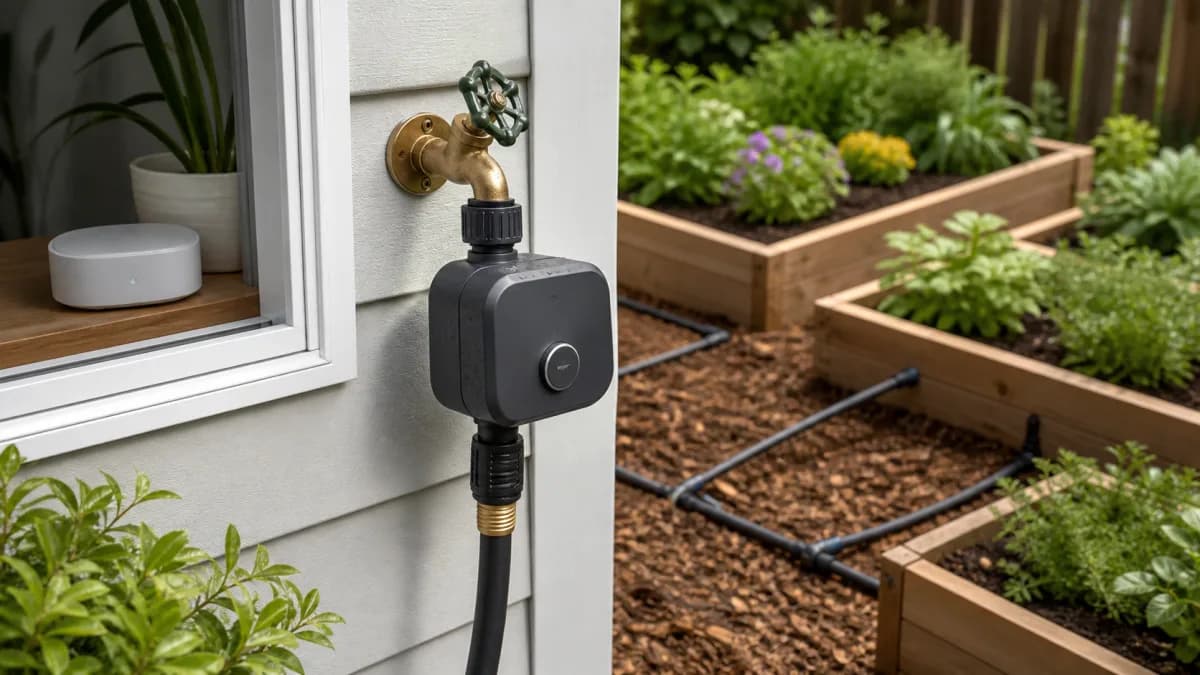
Original editorial image for category, fit, and use context; verify the exact linked product appearance and configuration on the retailer page.
Separate a hose zone from an in-ground zone
A hose timer controls the water path attached to one faucet. It suits drip lines, small sprinklers, containers, and temporary zones when the supply and flow are adequate. It does not replace a multi-zone controller when several buried valves must be sequenced, nor does it solve poor pressure, clogged filters, unsuitable emitters, or plumbing that requires repair.
Account for the hub and exterior wall
Some valves communicate by Bluetooth to an indoor hub that connects by 2.4GHz Wi-Fi. Confirm both radio legs. Put the hub where it has reliable router service and a practical path to the faucet, then test with doors closed and normal appliances operating. Open-air range is not a promise through masonry, foil insulation, metal siding, or dense landscaping.
Design the water path for support and leaks
Confirm hose-thread size, operating pressure, cold-water restrictions, valve orientation, filter, regulator, backflow prevention, splitter, and the weight hanging from the faucet. Support hoses so they do not lever the valve sideways. After assembly, open the upstream faucet slowly, run a supervised cycle, and inspect each joint both while flowing and while closed.
Prefer useful behavior without the cloud
Understand where schedules are stored, how many runs remain available without internet, what the physical button does, and how low batteries or a disconnected hub are reported. Rain skip can reduce unnecessary watering but should not be treated as a soil sensor. Keep an accessible manual shutoff and check that the valve actually opened and closed during early runs.
Plan batteries and winter storage
Use the specified batteries and keep the compartment seal clean and correctly fastened. Inspect for corrosion or water entry during the season. Remove, drain, clean, and store the valve before freezing weather according to the instructions; outdoor use does not imply freeze survival. At the start of each season, replace questionable seals and test every zone under observation.
Current Amazon option
Check this exact product
Rachio Smart Hose Timer with One Valve and WiFi Hub
ASIN
B0BWXZWJ1C
Brand
Rachio
Listing checked
8/10/2026
Compare the current title, ASIN, variant, seller, stock, shipping, price, and return path before ordering.
Exact one-valve plus Wi-Fi-hub starter kit anchor; recheck bundle, seller, and availability before publication.
Public owner context
Questions to answer before buying
Community discussions help surface installation, fit, maintenance, and failure questions. They are anecdotal context, not product specifications or a substitute for current instructions.
Used to identify recurring questions about reliability, Wi-Fi, manual operation, and alternatives; individual experiences are not reproduced as product test results.
Research notes
How we evaluated these choices
1.Draw the faucet, valve, filter, backflow device, regulator, hose, and emitters as one water path.
2.Place the hub and test radio reliability at the real exterior wall before building schedules around it.
3.Run short supervised cycles, inspect every joint, and measure whether the last emitter receives adequate flow.
4.Document batteries, winter removal, manual shutoff, local schedules, and the person responsible for visual checks.