Dwellwise Picks
Browse
Automation basics

Leak Sensor to Automatic Water Shutoff: Build a Safer Response Chain

Current retailer option

Aqara Water Leak Sensor 3 Pack & Zigbee Hub Kit

Open the named Aqara Water Leak Sensor 3 Pack & Zigbee Hub Kit listing to compare the live price, availability, delivery, seller, and returns.

Connect point detection, a local alarm, household notifications, a compatible valve, supervised closure, manual fallback, and recovery without trusting one cloud rule.

Prepared by the Dwellwise Picks editorial deskUpdated July 22, 2026

Quick answer

The practical answer

Cover water heaters, washers, sump areas, dishwashers, refrigerator lines, toilets, sink cabinets, and HVAC condensate according to the home's risk. A single sensor beside the main valve cannot detect every leak early.

Related search answers

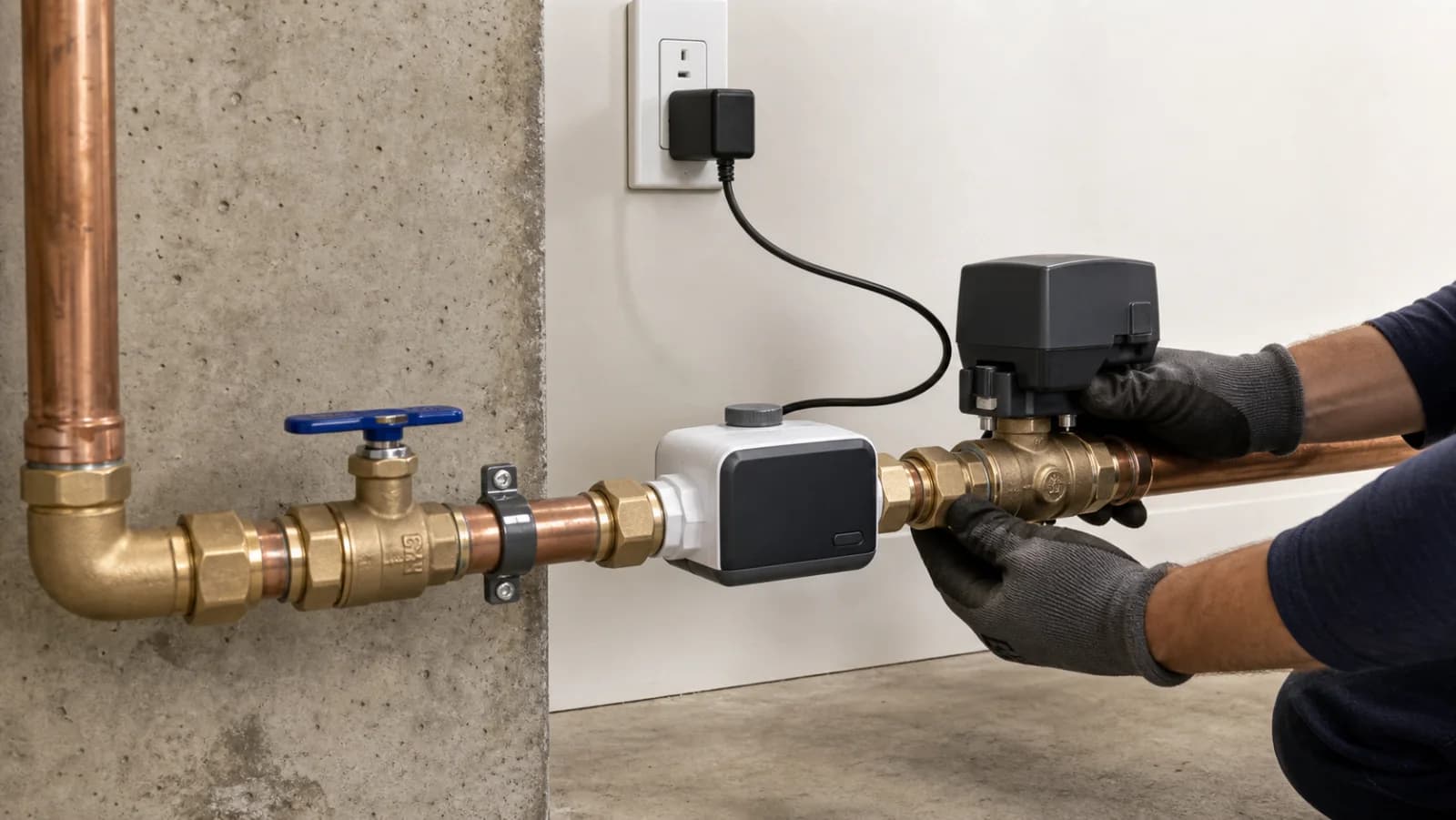
Professional check of an inline smart water shutoff installed after a manual valve
Editorial image for visual context; device appearance and configuration can vary by model and region.

1. Place sensors where water appears first

Cover water heaters, washers, sump areas, dishwashers, refrigerator lines, toilets, sink cabinets, and HVAC condensate according to the home's risk. A single sensor beside the main valve cannot detect every leak early.

2. Keep a local alarm

A hub, siren, or sensor alarm should make the problem obvious to someone at home even if phone permissions, Wi-Fi, the router, or a cloud service fails. Name every sensor by location.

3. Add the narrowest safe closure rule

Use only verified leak sensors to command the main valve, include household notifications, and avoid unrelated humidity or flaky contact signals. For a new system, test notification-only behavior before enabling automatic closure.

4. Test local and cloud paths separately

Verify sensor-to-hub, hub-to-actuator, device-to-device control if supported, app push, email or SMS, household sharing, battery alerts, internet loss, hub power loss, and manual button operation. One successful app tap does not validate the chain.

5. Use a supervised wet test

Follow the sensor maker's safe test method while someone stands at the valve. Confirm detection, alarm, notification, full closure, app state, and manual access. Never create uncontrolled water flow just to prove automation.

6. Reopen only after inspection

A closed valve is evidence, not a repair. Find the water source, inspect for damage, involve a plumber or appliance professional when needed, then reopen slowly while watching the affected area.

7. Schedule maintenance

Test sensors, notifications, battery status, actuator motion, manual shutoff access, and household instructions on a recurring schedule and after hub, router, app, firmware, plumbing, or valve changes.

Side-by-side checks

Every layer in the response chain

CheckLayerPrimary jobFailure to test
Point sensorDetect water where it first appearsLeak flows around or never reaches sensorConfirm before purchase
Local alarmWake or alert someone nearbyPhone-only alert is missedConfirm before purchase
NotificationReach household away from homePermissions, account, or internet failsConfirm before purchase
Valve actionStop the compatible water pathMotor stalls or closes wrong lineConfirm before purchase
Manual recoveryInspect, repair, reopen safelyWater returns before cause is fixedConfirm before purchase

Primary sources

References used for this guide

Buying framework

What to check before you choose

Checklist

  • Confirm the exact lock, doorbell, thermostat, controller, and ecosystem versions before buying.
  • Check what remains available locally when Wi-Fi, cloud service, or a subscription is unavailable.
  • Map wiring, door dimensions, radio coverage, storage, and household access before installation.

Common mistakes

  • Treating Matter, Thread, Zigbee, Wi-Fi, and Bluetooth as interchangeable labels.
  • Buying an ecosystem feature before confirming the required hub, controller, or border router.
  • Ignoring subscription boundaries, batteries, replacement access, and emergency fallback controls.

Category checks

  • Matter is an application standard; Thread and Zigbee are network technologies.
  • A Matter controller and a Thread border router are different roles.
  • Prefer physical and local fallback controls for essential routines.

Decision rule

Choose the device with the clearest compatibility and local fallback path; add premium ecosystem features only when they remove a recurring household problem.

Related guide

Water Leak Sensor Placement Guide

Put sensors where water appears first: under appliances, inside sink cabinets, by shutoff valves, near sump pumps, and around basement equipment.

Related guide

Wi-Fi vs Zigbee vs LoRa Water Leak Sensors

Choose the radio by room and response plan: simple Wi-Fi gateway kits, hub-based Zigbee automations, or long-range LoRa for basements and outbuildings.

Related guide

Smart Water Shutoff Valve Fit Checklist

Check valve type, pipe size, handle sweep, torque, clearance, power, Wi-Fi, hub, fire-system boundaries, and manual access before buying an actuator or inline shutoff.

Related guide

Matter Over Thread Hub: Controller and Border Router Checklist

Match the Matter controller, Thread border router, Wi-Fi path, ecosystem, and accessory before buying a hub for Matter over Thread devices.

Related product guide

Aqara Water Leak Sensor 3 Pack & Zigbee Hub Kit

A buying guide for the Aqara water-leak kit listing, focused on Zigbee hub requirements, phone alerts, local hub alarm behavior, and whether an Aqara ecosystem is worth choosing for leak detection.

Related product guide

YoLink LoRa Smart Water Alarm Bundle

A buying guide to the YoLink LoRa leak-alarm bundle, including the hub, two water leak sensors, wireless siren, long-range claims, optional SMS/email/push alerts, and device-to-device alarm pairing.

Related product guide

Aqara Valve Controller T1

A battery-powered Zigbee retrofit actuator for compatible lever or butterfly valves, with Aqara-hub automation, Matter-over-bridge support, manual control, and valve-fit limits.

Related product guide

YoLink X3 Valve Controller & Bulldog Valve Robot

A battery-powered LoRa controller and bolt-on Bulldog actuator for an existing ball valve, with device-to-device pairing, long-range placement, IP67 controller housing, and official product documentation.

Related product guide

Moen Flo 3/4-Inch Smart Water Shutoff 900-001

An inline 3/4-inch smart water monitor and shutoff with flow, pressure, temperature, remote and automatic closure, exact pipe-size variants, power and Wi-Fi requirements, and professional-installation risks.

Related comparison

Best Water Leak Sensors for Sinks, Water Heaters and Basements

Compare Aqara, Govee, X-Sense, and YoLink by sensor count, hub requirements, alarm path, wireless range, and the rooms each kit should cover first.

Related comparison

Best Smart Water Shutoff Valves: Retrofit and Inline Picks

Compare Aqara T1, YoLink X3 Bulldog, and Moen Flo by valve fit, radio path, local automation, pipe work, power, flow monitoring, and manual fallback.

Leak Sensor to Automatic Water Shutoff: Build a Safer Response Chain