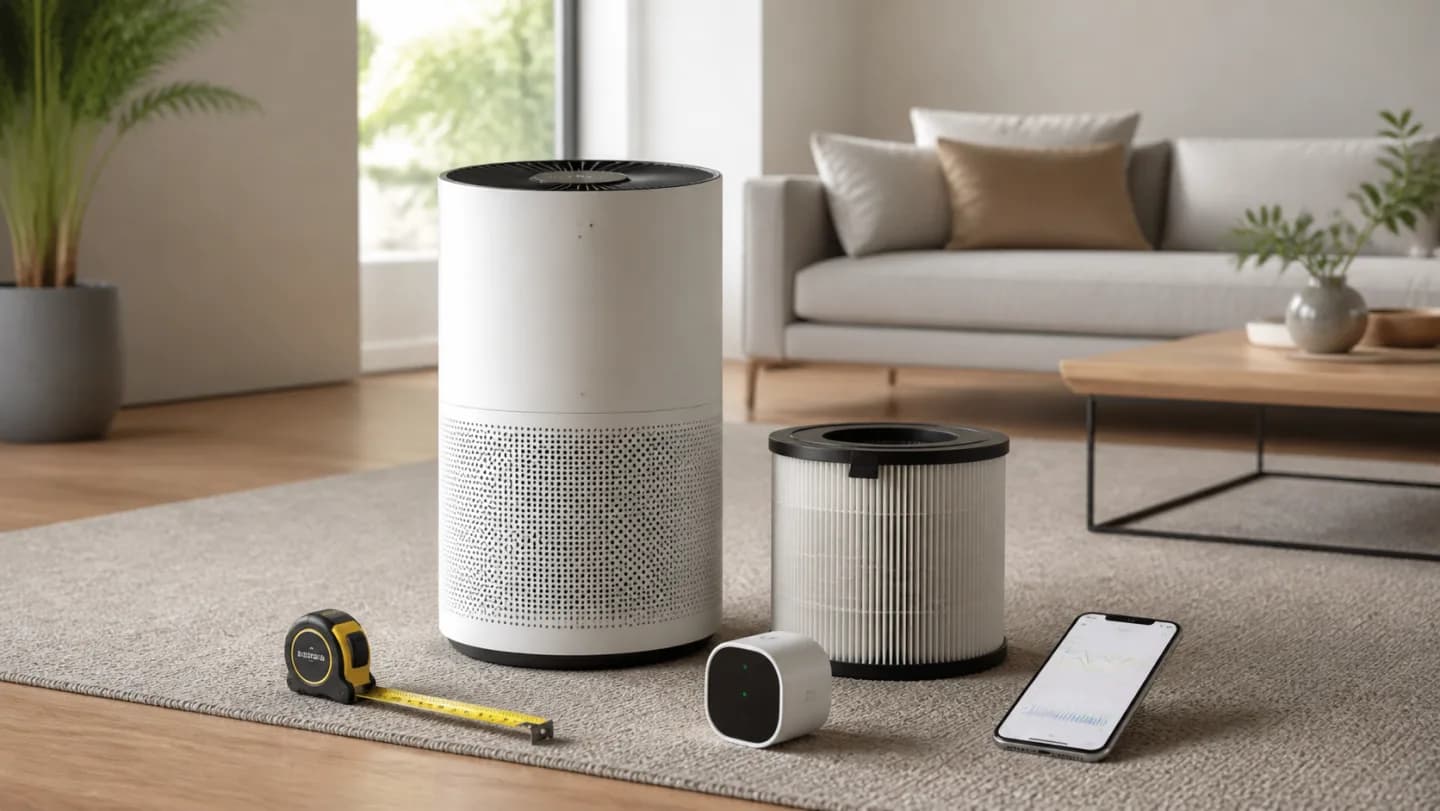
Size from clean-air delivery
Measure the room and use verified CADR for the exact model. A headline such as coverage up to a very large area may describe one air change per hour, while smoke, allergy, or shared-room goals often need faster circulation. Door position, ceiling height, furniture, and connected spaces alter the result, so leave capacity margin rather than buying at the claim's edge.
Match filtration to the pollutant
A particle filter can capture smoke particles, pollen, dust, and dander that reach it, but it cannot remove a source or guarantee control of every gas. Thin carbon layers have limited capacity for persistent odors and VOCs. Fix moisture, combustion, litter, cooking, or chemical sources first, ventilate appropriately, and use filtration as one layer.
Do not let auto mode idle the machine
Built-in sensors usually sample particles near the unit, not every breathing zone, and may respond differently to humidity or non-particle pollutants. Observe whether auto mode reduces speed too aggressively. A steady manual speed that the household tolerates can deliver more predictable cleaning; an independent monitor may help with trends but is not a diagnostic instrument.
Budget the exact filter path
Record the filter code for the selected Core 400S-P variation, current official replacements, change method, and availability. Avoid assuming visually similar third-party filters have identical media, fit, resistance, or safety. Vacuuming the exterior prefilter can protect airflow when the manual allows it, but washing a non-washable main filter can damage performance.
Keep smart features subordinate to airflow
Schedules, remote speed changes, filter reminders, and trend history can improve consistency. Confirm essential buttons remain on the purifier, shared household access is workable, and loss of Wi-Fi does not stop cleaning. Review app permissions and account recovery, then judge the product on sustained clean-air delivery, sound, maintenance, and energy rather than notification volume.